De Minimis Indirect Cost Rate: The 15 Percent Many Nonprofits Are Not Asking For
There is a number that decides whether your federal grants pay for the organization that delivers them, or whether your unrestricted money quietly does it instead. Most nonprofits know the number exists. Fewer have checked it recently, and a surprising share are still using the old one.
What the de minimis rate actually is
If your organization receives federal funding and does not have a federally negotiated indirect cost rate, the rule itself lets you elect a de minimis rate instead. No negotiation, no rate proposal, no back and forth with a cognizant agency. You elect it and apply it.
Indirect costs are the real costs of running the organization that are not attributable to one specific program. Facilities. General administration. The finance function. The work that makes the program possible without appearing anywhere in the program budget.
The de minimis rate exists because the alternative, negotiating a rate, is a meaningful administrative lift that small organizations often cannot justify. So the rule offers a simplified route.
What changed, and when
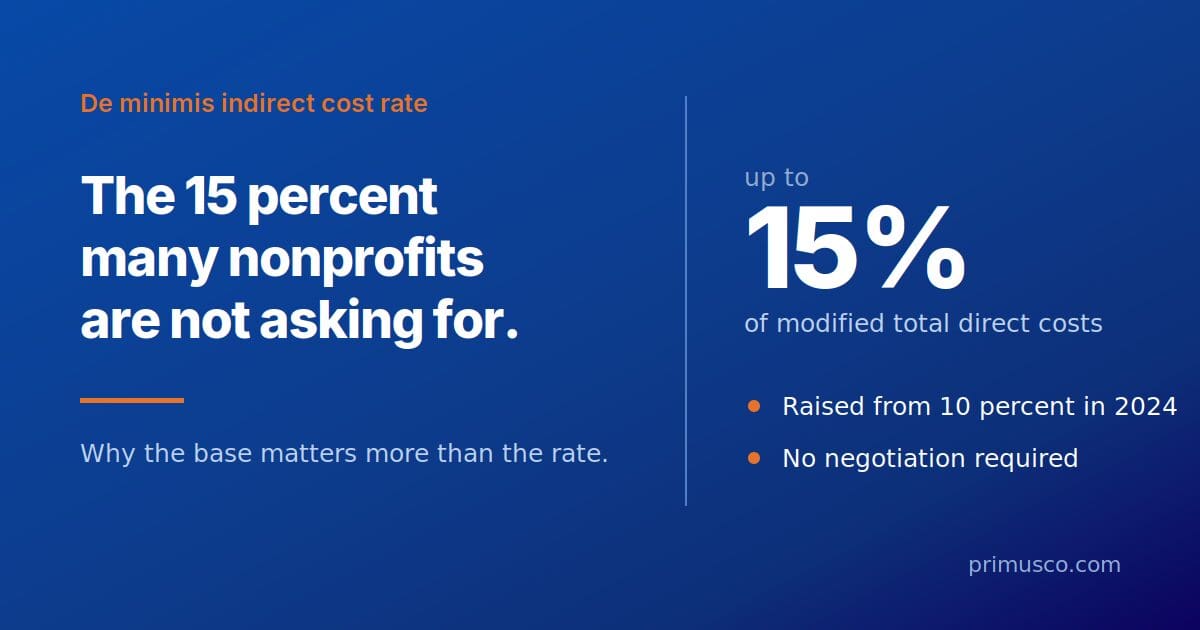
The de minimis rate used to be 10 percent. The 2024 revisions to the Uniform Guidance raised it to up to 15 percent, effective October 1, 2024.
The date matters. The 15 percent rate applies to new awards issued on or after October 1, 2024. Awards issued before that date stay at the old rate unless the awarding agency amends them to adopt the 2024 revisions. So if your current grant is still running at 10 percent, that is probably correct rather than an error, and it is worth knowing which of your awards sit on which side of that line.
Two years on, we still see proposals budgeted at 10 percent, and proposals with no indirect line at all because somebody decided it was simpler not to ask. Both are money an organization chose not to request.
The base is where organizations lose money
This is the part that costs more than the percentage does.
The de minimis rate is applied to modified total direct costs, not to total direct costs and not to the grant as a whole. Modified total direct costs is a trimmed version of your direct costs. Several categories come out of the base before the rate is applied, and only the first portion of each subaward counts toward it.
The practical consequence is that 15 percent of modified total direct costs recovers less than 15 percent of what most people picture when they hear the phrase indirect rate. An organization with a large subaward or significant excluded costs can apply the rate correctly and still find the recovery smaller than expected.
This cuts both ways. Budget the rate against the wrong base and the proposal is wrong before a program officer reads it. Build it against the right base and you stop being surprised later by the gap between what you asked for and what arrived.
We are deliberately not reproducing the full list of exclusions here, because the list is long, the items interact, and a partial version of it does more harm than no version at all. If you are building a budget, work from the definition itself or ask someone to walk the base with you.
The words up to are doing real work
Fifteen percent is a ceiling, not an entitlement.
You need indirect costs that support the rate you claim. If your actual indirect costs come to less than 15 percent of the base, claiming the full 15 is not a rounding decision. And the de minimis recovery is testable: audit procedures look at whether the organization genuinely has no current negotiated rate, whether the rate was applied consistently, and whether it was applied to the correct base.
One more thing worth knowing. You do not get to use the de minimis rate on one federal award and a negotiated rate on another. Consistency is part of the deal.
Why this is not just an accounting question
It is tempting to file indirect cost recovery under things the bookkeeper handles. It belongs further up than that.
Indirect recovery is the difference between a program that funds its own overhead and a program that quietly subsidizes itself out of unrestricted money. Most organizations that feel permanently stretched on operations, where the finance person is also the HR person and nobody has time to document anything, are not badly managed. They are funding their infrastructure out of the wrong pocket, one grant at a time, for years.
The sector has spent a long time treating overhead as something to minimize and apologize for. The rules do not actually require that. They provide a mechanism for recovering it. Many organizations simply are not using the mechanism.
What to check this month
Four things, and none of them take long.
Whether your organization has a current federally negotiated rate. Some organizations have one and the person writing proposals does not know.
What rate your last three proposals used. If any said 10 percent, check the award date.
What base those budgets applied the rate to. If it was total direct costs rather than modified total direct costs, the number is wrong.
Whether your actual indirect costs support the rate you are claiming, because that is what you can prove if someone asks.
October is the quiet month. Nothing is due, which is exactly why it is the right time to look.
If you want a second set of eyes on your indirect rate or your budget base, our back office assessment is free and there is no sales call attached. Or take the five minute compliance assessment at primusco.com/compliance-assessment and see which questions actually apply to your organization.