
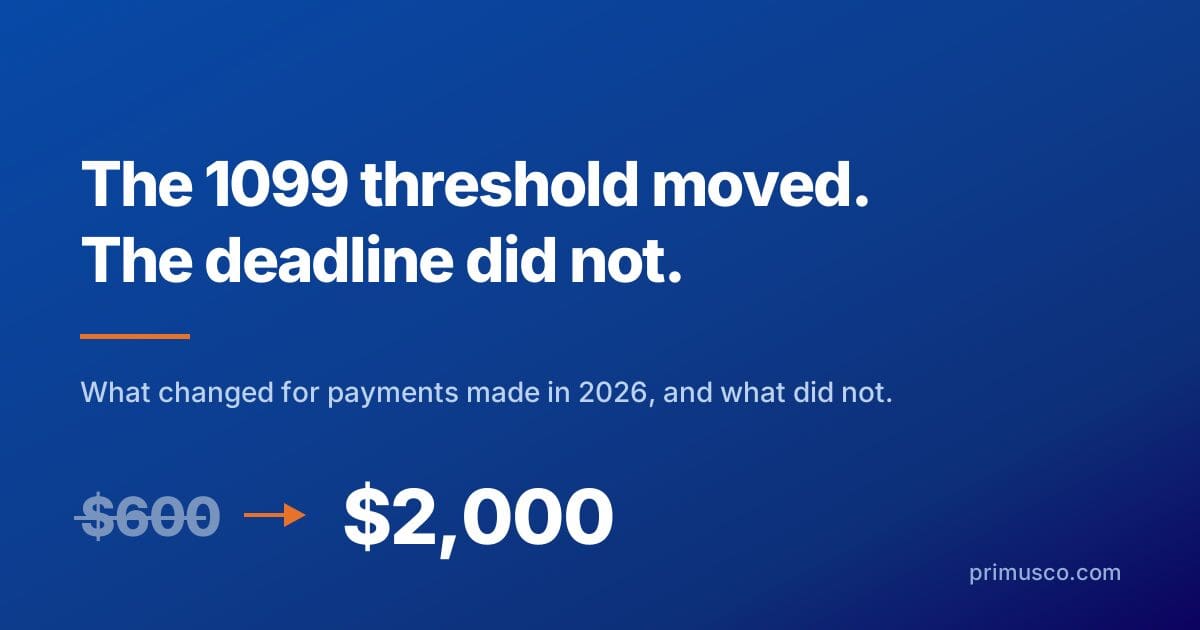
The 1099 Threshold Moved to $2,000. Here Is What Did Not Move.
Most nonprofits will issue fewer 1099s this January than they did last year. The threshold for nonemployee compensation went from $600 to $2,000 for payments made in 2026, and for a small organization that is a meaningful reduction in paperwork.
It is also the point at which a lot of organizations are going to make a quiet mistake, because the threshold change affects one thing and leaves three others exactly where they were.
What changed
For payments made after December 31, 2025, the reporting threshold for nonemployee compensation on Form 1099-NEC is $2,000. The change came through Section 70433 of the reconciliation law enacted in July 2025, amending Section 6041 of the Internal Revenue Code. The forms you prepare in January 2027 are the first ones filed under the new rule.
The $600 figure it replaced had been unchanged since the 1950s and was never indexed for inflation, which is why it had come to cover nearly every vendor a nonprofit engaged. The new $2,000 threshold will be adjusted annually beginning in 2027.
The same threshold applies to non-wage payments reported on Form 1099-MISC and to the backup withholding rules underneath both forms.
What did not change: the W-9
The threshold decides whether you issue a form. It does not decide whether you collect a W-9.
If your internal rule becomes “request a W-9 once a vendor passes $2,000,” you have built a gap you cannot close later. You do not know in February what a vendor will total by December. A consultant who starts at $800 and finishes the year at $3,400 is a form you have to produce, and by January that person has finished the engagement and has very little reason to answer an email about tax paperwork.
Collect the W-9 before the first payment, from every vendor, at any amount. It takes the vendor four minutes while they are still waiting to be paid. Chasing it in January takes you a month.
There is a second reason beyond the tax form. Your vendor file is audit documentation. A reviewer examining procurement and payment records is not counting your 1099s. They are checking whether you can show who you paid, why, and under what agreement. Fewer tax forms does not make that file less necessary.
What did not change: backup withholding
The IRS instructions for Forms 1099-MISC and 1099-NEC state that you must file a Form 1099-NEC for each person from whom you withheld any federal income tax under the backup withholding rules, regardless of the amount of the payment.
A $400 payment with backup withholding applied to it still requires a form. The $2,000 threshold does not reach it.
Backup withholding is most commonly triggered by a missing or invalid taxpayer identification number, which points back to the same practice. Organizations that collect W-9s on the front end rarely encounter backup withholding. Organizations that do not, encounter it on exactly the small payments the new threshold would otherwise have excused.
What did not change: the deadline
January 31 remains the due date for both furnishing recipient copies and filing with the IRS.
January 31, 2027 falls on a Sunday. Under the standard next business day rule, the deadline moves to Monday, February 1, 2027.
Two details worth holding onto. Form 1099-NEC gets no additional month for electronic filing, unlike some other forms in the 1099 family. And Form W-2 runs on the same calendar, with employee copies and the SSA filing due that same Monday. Your payroll deadline and your contractor deadline are the same date.
A six week checklist
- Pull the vendor payment report for January 1 through today, sorted by total paid.
- Mark everyone above $2,000. Those are forms. Confirm you hold a current W-9 for each.
- Review everyone below $2,000. This is where the errors are. Check for backup withholding, check who is likely to cross the threshold in December, and check whether a W-9 exists at all.
- Send W-9 requests this month. November requests get returned. Late January requests get ignored.
- Confirm classification. The threshold change does nothing to the rules separating contractors from employees. A misclassified worker is a far more expensive finding than a late form.
- Reconcile the vendor list against your general ledger so the totals you are reporting match the payments you actually made.
The real lesson
A reporting threshold is a filing instruction. It tells you which transactions generate a piece of paper for the IRS. It was never a standard for how carefully an organization should track the people it pays.
Nonprofits that treated the $600 rule as their vendor documentation policy are about to discover that the policy was never theirs to begin with. It belonged to the tax code, and the tax code moved it.
If your back office was already collecting W-9s on day one and reconciling the vendor file through the year, this change is simply less work in January. If the threshold was doing that job for you, you have six weeks to replace it.
PRIMUS Business Management builds back office systems for nonprofits that hold up to a funder, an auditor, and a filing deadline. If your vendor file has not been reconciled this year, request a free back office assessment.